
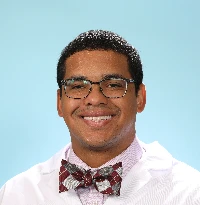
LeMoyne Habimana-Griffin, MD, PhD, is a Clinical Instructor in the Department of Human Oncology at the University of Wisconsin–Madison and a Bentson Translational Research Fellow. He is a physician-scientist in radiation oncology whose research focuses on how the microbiome influences the efficacy and toxicity of cancer therapies, particularly radiotherapy.
He earned his Bachelor of Science in Biomedical Engineering from Rose-Hulman Institute of Technology, graduating summa cum laude and receiving the John T. Royse Award as the most outstanding graduate. Dr. Habimana-Griffin went on to earn his MD and PhD in Biomedical Engineering from Washington University in St. Louis, where his doctoral work under Dr. Samuel Achilefu focused on optical molecular imaging to study cancer and Alzheimer’s disease. He completed his residency in Radiation Oncology at Washington University, including the American Board of Radiology Holman Research Pathway. During this time, he pursued postdoctoral research in the laboratory of Dr. Gautam Dantas, investigating interactions between the microbiome and radiation therapy.
His current research integrates preclinical models and patient-derived biospecimens to define how microbial composition and metabolism shape treatment response and normal tissue toxicity. His work aims to identify modifiable microbiome-mediated pathways that can be leveraged to improve the therapeutic ratio of cancer treatment. Dr. Habimana-Griffin has received support from national funding organizations, including the Radiological Society of North America and Conquer Cancer, and is committed to building a translational research program that bridges microbiome science and precision oncology to improve outcomes and quality of life for cancer patients and survivors.
Disclosures:
- Employment: University of Wisconsin School of Medicine and Public Health/University of Wisconsin Medical Foundation:Clinical Instructor:Employee
- Compensation: :Role Topic Description-End Date:
- Ownership: none
- Leadership: none